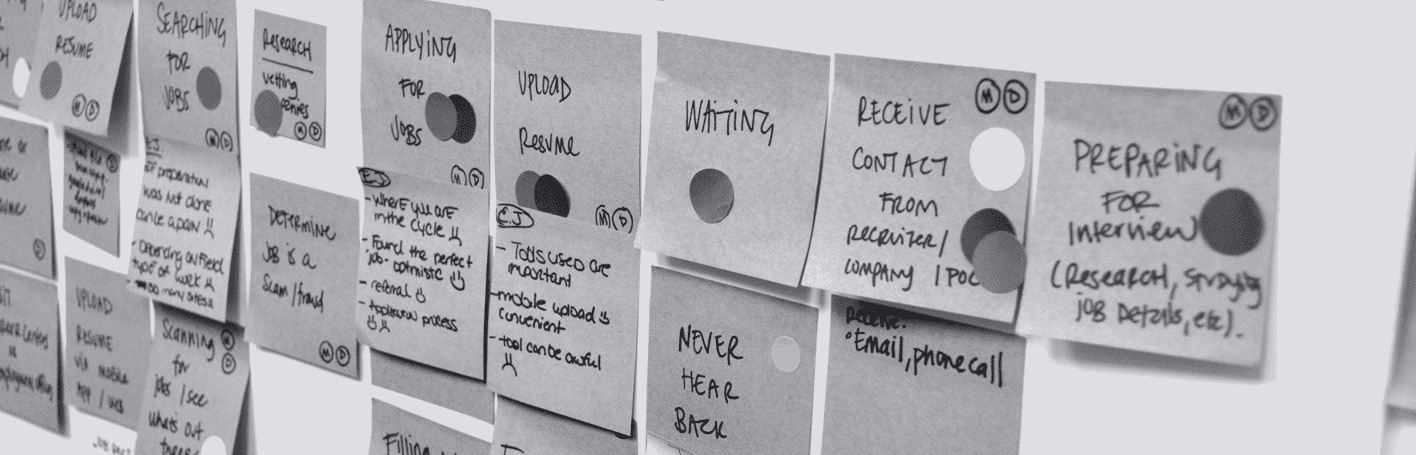
Early product design work at CareerBuilder
As an early-career designer, one of top contributions was an empty state design that boosted resume uploads by 92% in its first quarter after launch.
Summary
While I initially joined as a visual designer, my role eventually evolved into that of a hybrid designer. I had the opportunity to contribute to and lead strategy, interaction design, and visual/UI design efforts on several B2B and B2C projects.
Timeline
Jan 2016–Jan 2017
Early product design work at CareerBuilder
As an early-career designer, one of top contributions was an empty state design that boosted resume uploads by 92% in its first quarter after launch.
Summary
While I initially joined as a visual designer, my role eventually evolved into that of a hybrid designer. I had the opportunity to contribute to and lead strategy, interaction design, and visual/UI design efforts on several B2B and B2C projects.
Timeline
Jan 2016–Jan 2017
Early product design work at CareerBuilder
As an early-career designer, one of top contributions was an empty state design that boosted resume uploads by 92% in its first quarter after launch.
Summary
While I initially joined as a visual designer, my role eventually evolved into that of a hybrid designer. I had the opportunity to contribute to and lead strategy, interaction design, and visual/UI design efforts on several B2B and B2C projects.
Timeline
Jan 2016–Jan 2017
Removing friction when applying for jobs
Problem
We noticed that job seekers were re-uploading resumes for every job application they submitted, which indicated a low awareness of a feature that allowed them to add their resume to their profile so it could be automatically be used when they apply.
This created friction and limited both application efficiency and employers' ability to proactively discover candidates.
Goal
We wanted to increase the number of people who added their resumes to their profiles, enabling easier applications and earlier candidate visibility.
What I did
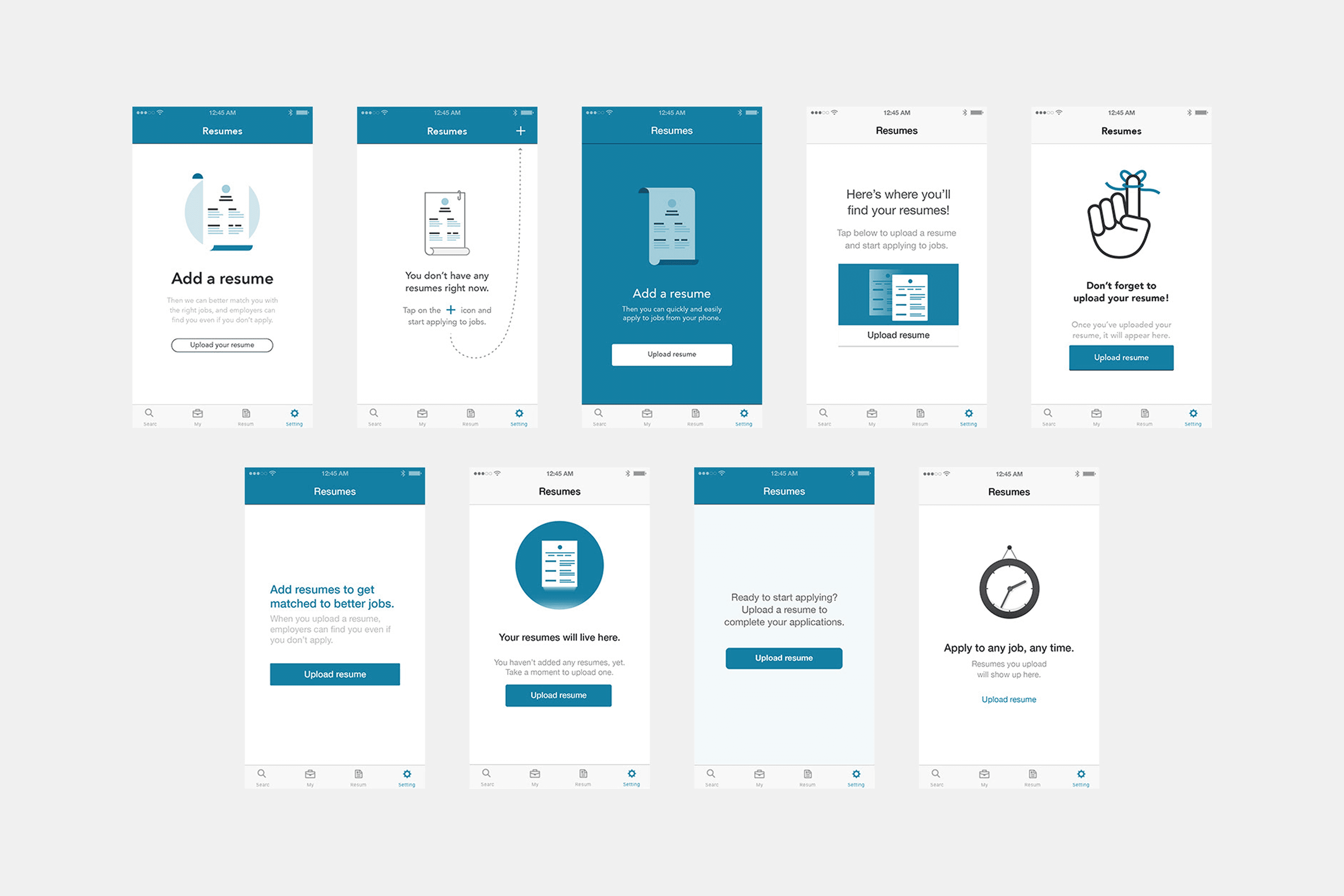
I focused on improving this moment in the journey by designing an empty state that educated users on profile-based resume uploads.
I crafted illustration and copy, exploring multiple directions, and collaborated with a senior designer (who coached me on workshop facilitation) and engineers on implementation.
Outcome
92% increase in resume uploads
Removing friction when applying for jobs
Problem
We noticed that job seekers were re-uploading resumes for every job application they submitted, which indicated a low awareness of a feature that allowed them to add their resume to their profile so it could be automatically be used when they apply.
This created friction and limited both application efficiency and employers' ability to proactively discover candidates.
Goal
We wanted to increase the number of people who added their resumes to their profiles, enabling easier applications and earlier candidate visibility.
What I did
I focused on improving this moment in the journey by designing an empty state that educated users on profile-based resume uploads.
I crafted illustration and copy, exploring multiple directions, and collaborated with a senior designer (who coached me on workshop facilitation) and engineers on implementation.
Outcome
92% increase in resume uploads
Removing friction when applying for jobs
Problem
We noticed that job seekers were re-uploading resumes for every job application they submitted, which indicated a low awareness of a feature that allowed them to add their resume to their profile so it could be automatically be used when they apply.
This created friction and limited both application efficiency and employers' ability to proactively discover candidates.
Goal
We wanted to increase the number of people who added their resumes to their profiles, enabling easier applications and earlier candidate visibility.
What I did
I focused on improving this moment in the journey by designing an empty state that educated users on profile-based resume uploads.
I crafted illustration and copy, exploring multiple directions, and collaborated with a senior designer (who coached me on workshop facilitation) and engineers on implementation.
Outcome
92% increase in resume uploads
Uncovering gaps in omni-channel experiences to drive future product development
Problem
Over the course of 20+ years, CareerBuilder had built up a wealth of qualitative and quantitative data about job seeker and employer behaviors. However, this data wasn’t being utilized to its full potential: the two lines of business, Consumer and Employer, were very siloed, and product teams didn’t know when, where, or how to adequately supply one another with relevant data and insights.
Goal
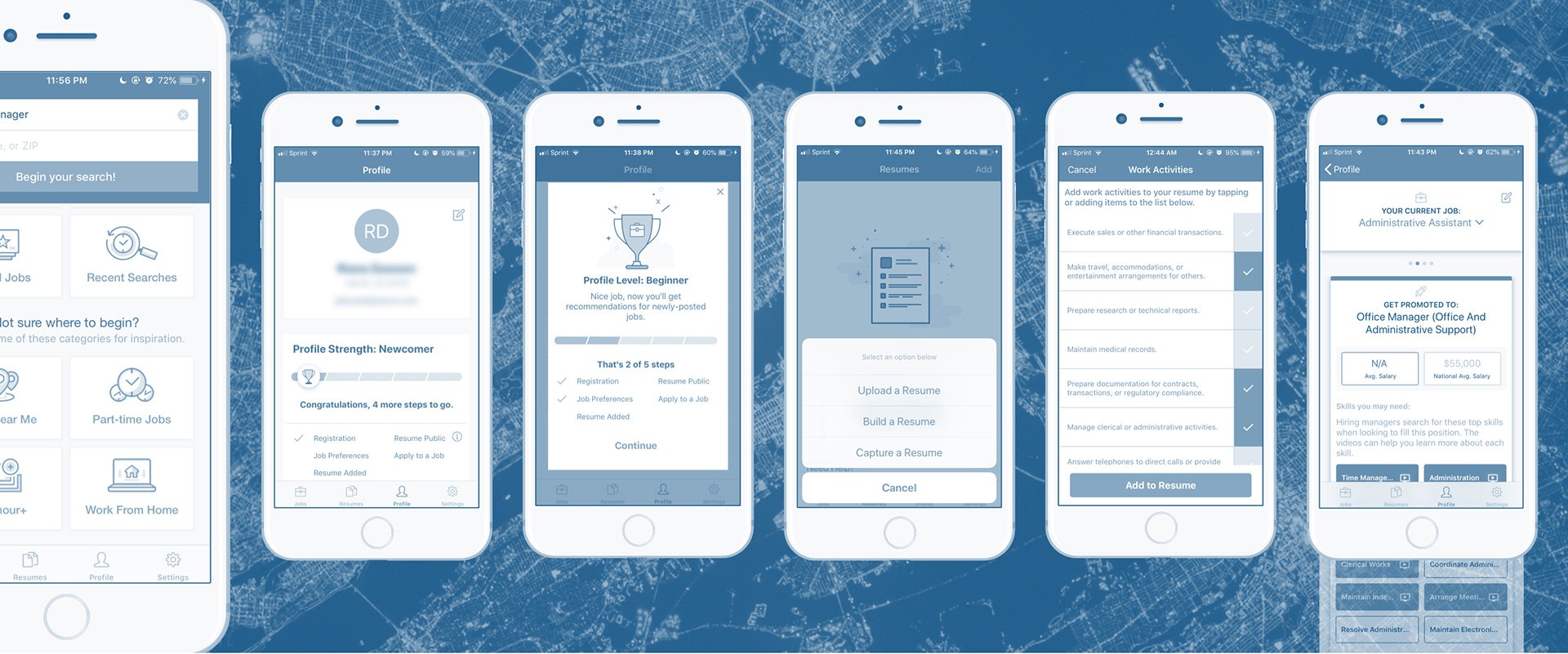
Our goal was to highlight breaks in the omni-channel experience and surface friction in overlooked process steps in order to help product teams understand these problems and view them as opportunities.
What I did
I led the conceptual design of the opportunities and eventual solutions that emerged from this work, and collaborated with my other team members (two Senior User Researchers and a Senior Interaction Designer) on research synthesis, workshop facilitation, and producing major deliverables to share with stakeholders.
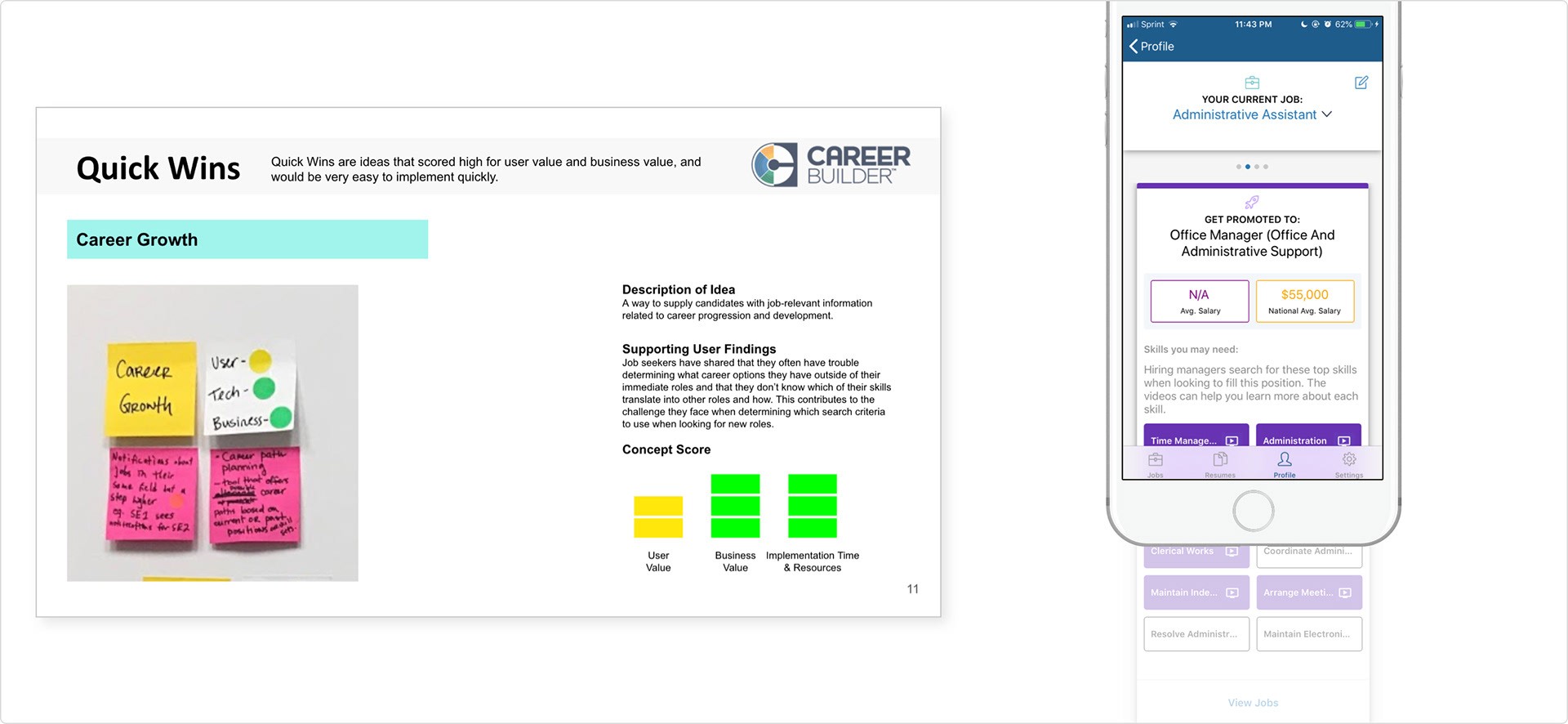
Also created quick sketches to illustrate workshop ideas to stakeholders, allowing us to move swiftly and get feedback early.
Outcome
We led a workshop with the Mobile Apps team to brainstorm opportunities, right as they were kicking off roadmap planning, using the outcomes of our synthesis work.
Many of our ideas, both Big Ideas and Quick Wins, made it into the backlog and were later developed. Some of those concepts are highlighted below. (Note: I did not produce the final designs)
Personal growth
This was my proudest achievement at CareerBuilder.
We set out to increase shared understanding across the organization to improve the end-to-end user experience. By proactively taking this on, we aligned the Mobile Apps team, influenced leadership, and demonstrated how research and strategic thinking can directly shape product direction.
We weren't asked to do this work and we all made time between our respective projects to work on this endeavor because we knew how much the organization could benefit from having this knowledge and perspective. As a result, we were able to align the Mobile Apps team, influence leadership, and demonstrate how research and strategic thinking can directly shape product direction.
Uncovering gaps in omni-channel experiences to drive future product development
Problem
Over the course of 20+ years, CareerBuilder had built up a wealth of qualitative and quantitative data about job seeker and employer behaviors. However, this data wasn’t being utilized to its full potential: the two lines of business, Consumer and Employer, were very siloed, and product teams didn’t know when, where, or how to adequately supply one another with relevant data and insights.
Goal
Our goal was to highlight breaks in the omni-channel experience and surface friction in overlooked process steps in order to help product teams understand these problems and view them as opportunities.
What I did
I led the conceptual design of the opportunities and eventual solutions that emerged from this work, and collaborated with my other team members (two Senior User Researchers and a Senior Interaction Designer) on research synthesis, workshop facilitation, and producing major deliverables to share with stakeholders.
Also created quick sketches to illustrate workshop ideas to stakeholders, allowing us to move swiftly and get feedback early.
Outcome
We led a workshop with the Mobile Apps team to brainstorm opportunities, right as they were kicking off roadmap planning, using the outcomes of our synthesis work.
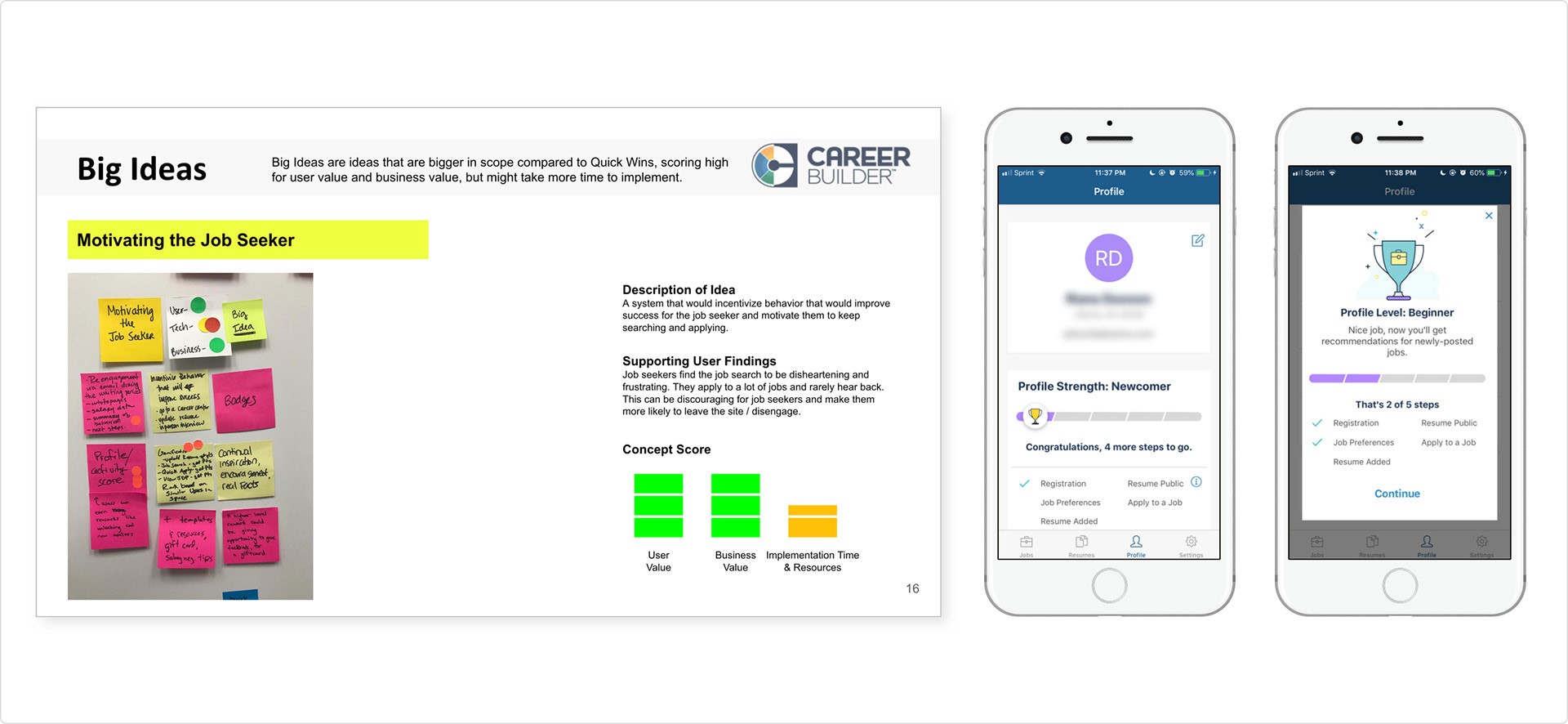
Many of our ideas, both Big Ideas and Quick Wins, made it into the backlog and were later developed. Some of those concepts are highlighted below. (Note: I did not produce the final designs)
Personal growth
This was my proudest achievement at CareerBuilder.
We set out to increase shared understanding across the organization to improve the end-to-end user experience. By proactively taking this on, we aligned the Mobile Apps team, influenced leadership, and demonstrated how research and strategic thinking can directly shape product direction.
We weren't asked to do this work and we all made time between our respective projects to work on this endeavor because we knew how much the organization could benefit from having this knowledge and perspective. As a result, we were able to align the Mobile Apps team, influence leadership, and demonstrate how research and strategic thinking can directly shape product direction.
Uncovering gaps in omni-channel experiences to drive future product development
Problem
Over the course of 20+ years, CareerBuilder had built up a wealth of qualitative and quantitative data about job seeker and employer behaviors. However, this data wasn’t being utilized to its full potential: the two lines of business, Consumer and Employer, were very siloed, and product teams didn’t know when, where, or how to adequately supply one another with relevant data and insights.
Goal
Our goal was to highlight breaks in the omni-channel experience and surface friction in overlooked process steps in order to help product teams understand these problems and view them as opportunities.
What I did
I led the conceptual design of the opportunities and eventual solutions that emerged from this work, and collaborated with my other team members (two Senior User Researchers and a Senior Interaction Designer) on research synthesis, workshop facilitation, and producing major deliverables to share with stakeholders.
Also created quick sketches to illustrate workshop ideas to stakeholders, allowing us to move swiftly and get feedback early.
Outcome
We led a workshop with the Mobile Apps team to brainstorm opportunities, right as they were kicking off roadmap planning, using the outcomes of our synthesis work.
Many of our ideas, both Big Ideas and Quick Wins, made it into the backlog and were later developed. Some of those concepts are highlighted below. (Note: I did not produce the final designs)
Personal growth
This was my proudest achievement at CareerBuilder.
We set out to increase shared understanding across the organization to improve the end-to-end user experience. By proactively taking this on, we aligned the Mobile Apps team, influenced leadership, and demonstrated how research and strategic thinking can directly shape product direction.
We weren't asked to do this work and we all made time between our respective projects to work on this endeavor because we knew how much the organization could benefit from having this knowledge and perspective. As a result, we were able to align the Mobile Apps team, influence leadership, and demonstrate how research and strategic thinking can directly shape product direction.