
Truist Bank
Hired as a Senior UX Designer in 2017 and promoted to Principal in 2021, I led design for internal tools supporting onboarding and ongoing service for commercial banking clients.
Summary
I led design for internal tools supporting commercial client onboarding, defining a forward-looking vision for client services. I shaped product strategy through UX metrics, drove cross-product alignment, and led research, workshops, and process improvements to elevate team effectiveness and decision-making.
Timeline
2017–2021
Truist Bank
Hired as a Senior UX Designer in 2017 and promoted to Principal in 2021, I led design for internal tools supporting onboarding and ongoing service for commercial banking clients.
Summary
I led design for internal tools supporting commercial client onboarding, defining a forward-looking vision for client services. I shaped product strategy through UX metrics, drove cross-product alignment, and led research, workshops, and process improvements to elevate team effectiveness and decision-making.
Timeline
2017–2021
Truist Bank
Hired as a Senior UX Designer in 2017 and promoted to Principal in 2021, I led design for internal tools supporting onboarding and ongoing service for commercial banking clients.
Summary
Truist Bank formed as a result of a merger between SunTrust and BB&T in December 2019. I joined SunTrust in May 2017 as a designer in the Commercial line of business. After the merger was announced, I continued my work within Commercial as our team of UI designers, UX designers, and researchers more than doubled in size.
As we worked toward “Client Day 1”, which was the day when people started transacting as Truist customers, our goal within Commercial was to provide corporate financial professionals and bank employees with the tools they need to keep their day-to-day operations up and running.
Timeline
2017–2021

Building an internal activity logging tool
Problem
Operations teams needed access to accurate and coherent activity data so they could research customer behavior and fulfill requests.
However, the tool they had been using made it difficult to access, trust, and interpret data, slowing down operations and decision-making, and these complications were exacerbated by the pending merger.
Goal
We needed to build a new activity logging tool that enables internal users to efficiently search, interpret, and act on user activity data, while laying the foundation for future client-facing capabilities.
What I did
As the design lead, I led experience strategy/design and MVP definition work, translating complex backend data into intuitive, task-based workflows.
This entailed conducting research (in partnership with a user researcher), defining user archetypes, structuring content, co-defining features and requirements with my PM, and designing scalable search/filter systems while balancing technical constraints, evolving scope, and cross-team dependencies.
Outcome
Launched MVP, but I left the company before impact metrics could be captured.
Personal growth
This project strengthened my skills in information architecture, especially structuring large datasets for search and discovery. I deepened my ability to design data-heavy experiences by translating complex, inconsistent backend data into clear, human-readable interfaces.
I also improved how I facilitate alignment through ambiguity, navigating shifting scope, prioritizing assumptions, and making thoughtful trade-offs between ideal UX and technical feasibility.
Building an internal activity logging tool
Problem
Operations teams needed access to accurate and coherent activity data so they could research customer behavior and fulfill requests.
However, the tool they had been using made it difficult to access, trust, and interpret data, slowing down operations and decision-making, and these complications were exacerbated by the pending merger.
Goal
We needed to build a new activity logging tool that enables internal users to efficiently search, interpret, and act on user activity data, while laying the foundation for future client-facing capabilities.
What I did
As the design lead, I led experience strategy/design and MVP definition work, translating complex backend data into intuitive, task-based workflows.
This entailed conducting research (in partnership with a user researcher), defining user archetypes, structuring content, co-defining features and requirements with my PM, and designing scalable search/filter systems while balancing technical constraints, evolving scope, and cross-team dependencies.
Outcome
Launched MVP, but I left the company before impact metrics could be captured.
Personal growth
This project strengthened my skills in information architecture, especially structuring large datasets for search and discovery. I deepened my ability to design data-heavy experiences by translating complex, inconsistent backend data into clear, human-readable interfaces.
I also improved how I facilitate alignment through ambiguity, navigating shifting scope, prioritizing assumptions, and making thoughtful trade-offs between ideal UX and technical feasibility.
Building an internal activity logging tool
Problem
Operations teams needed access to accurate and coherent activity data so they could research customer behavior and fulfill requests.
However, the tool they had been using made it difficult to access, trust, and interpret data, slowing down operations and decision-making, and these complications were exacerbated by the pending merger.
Goal
We needed to build a new activity logging tool that enables internal users to efficiently search, interpret, and act on user activity data, while laying the foundation for future client-facing capabilities.
What I did
As the design lead, I led experience strategy/design and MVP definition work, translating complex backend data into intuitive, task-based workflows.
This entailed conducting research (in partnership with a user researcher), defining user archetypes, structuring content, co-defining features and requirements with my PM, and designing scalable search/filter systems while balancing technical constraints, evolving scope, and cross-team dependencies.
Outcome
Launched MVP, but I left the company before impact metrics could be captured.
Personal growth
This project strengthened my skills in information architecture, especially structuring large datasets for search and discovery. I deepened my ability to design data-heavy experiences by translating complex, inconsistent backend data into clear, human-readable interfaces.
I also improved how I facilitate alignment through ambiguity, navigating shifting scope, prioritizing assumptions, and making thoughtful trade-offs between ideal UX and technical feasibility.
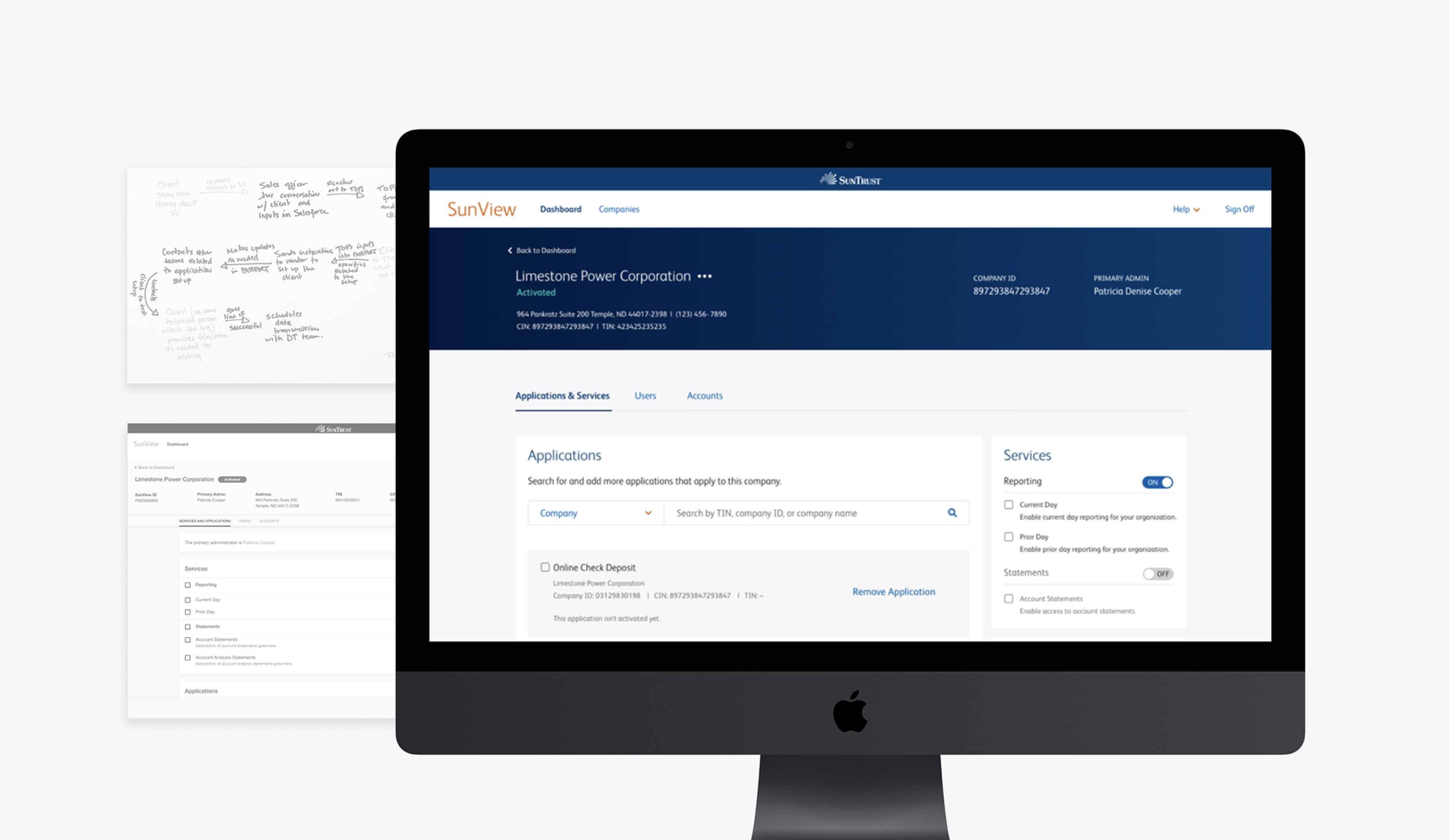
Improving client onboarding
Problem
SunTrust needed a scalable way to onboard 10,000+ commercial clients onto its new SSO platform. The existing third-party tool (CDU) caused failures, inefficiencies, and heavy manual effort, making migration unscalable.
Goal
Our goal was to create a flexible onboarding experience that reduced migration failures, enabled self-service, and streamlined the process so clients can be onboarded efficiently at scale without increasing operational burden.
What I did
As the design lead of this initiative, I led UX strategy, discovery, and interaction design.
I partnered cross-functionally to reframe the problem, consolidate multiple onboarding paths into a single flexible system, and design workflows, blueprints, and usability-tested solutions under tight constraints and legacy system limitations.
Outcome
75% faster onboarding time (2 hr avg. → 38 min)
55% increase in onboarding volume over 3 months
Improving client onboarding
Problem
SunTrust needed a scalable way to onboard 10,000+ commercial clients onto its new SSO platform. The existing third-party tool (CDU) caused failures, inefficiencies, and heavy manual effort, making migration unscalable.
Goal
Our goal was to create a flexible onboarding experience that reduced migration failures, enabled self-service, and streamlined the process so clients can be onboarded efficiently at scale without increasing operational burden.
What I did
As the design lead of this initiative, I led UX strategy, discovery, and interaction design.
I partnered cross-functionally to reframe the problem, consolidate multiple onboarding paths into a single flexible system, and design workflows, blueprints, and usability-tested solutions under tight constraints and legacy system limitations.
Outcome
75% faster onboarding time (2 hr avg. → 38 min)
55% increase in onboarding volume over 3 months
Improving client onboarding
Problem
SunTrust needed a scalable way to onboard 10,000+ commercial clients onto its new SSO platform. The existing third-party tool (CDU) caused failures, inefficiencies, and heavy manual effort, making migration unscalable.
Goal
Our goal was to create a flexible onboarding experience that reduced migration failures, enabled self-service, and streamlined the process so clients can be onboarded efficiently at scale without increasing operational burden.
What I did
As the design lead of this initiative, I led UX strategy, discovery, and interaction design.
I partnered cross-functionally to reframe the problem, consolidate multiple onboarding paths into a single flexible system, and design workflows, blueprints, and usability-tested solutions under tight constraints and legacy system limitations.
Outcome
75% faster onboarding time (2 hr avg. → 38 min)
55% increase in onboarding volume over 3 months